
.png)
A catch up of some of the best examples of IP licensing in video games and the latest news on collaborations, brand partnerships and in-game events.
With content integrations across genres increasingly theme or event driven, we thought this month, as well as looking at what else has been announced, we would look at a particular IP genre and how its doing in video games of all types.
We will do this now again and for this month, we have decided to focus on the Horror genre.
Prior to that we take a wider lens look at what has been working and why when it comes to licensed games and collaborations.
You can find all of this below, along with some of the biggest news stories covering the latest games and collaborations utilising well known IP.
But before we get to that, we wanted to update you on what we have been doing at Layer since the acquisition of the marketplace and brand by UK based licensing agency AT New Media.
Well, it has pretty much been a lot of housekeeping from managing active versus inactive users through to deal closure and new proposal support. New and renewed engagements with brands and developers and we are keen to keep that progressing so do get in touch for a chat if you would like to. Any fundamental changes to the Layer app ecosystem itself are not immediately planned but we have ideas for sure.
For further information, please reach out to Simon@layerlicensing.com
Now and again throughout the year, we like to review ongoing insights and what we can expect heading in to the rest of the year and beyond when it comes to licensed content in video games as a whole.
So let’s not waste any time and get to it.
Remember you can always find additional examples in our collab tracker which will always encompass examples of those supported via the Layer marketplace and some brilliant off marketplace examples also….
So here are some initial ongoing trends of note:
Hollywood and the video game industry continue to see strategic licensing deals that bring story IP into games and vice-versa, often blending cinematic universes with interactive experiences.
Partnerships between studios and major brands (e.g., Netflix, Lionsgate with Roblox) empower creators to embed well-known characters into UGC environments.
Away from the traditional AAA games, many live service games (e.g., Fortnite and Roblox) and mobile titles will increasingly announce licensed IP integrations or modular crossovers as part of seasonal live events and official content drops. This is where even more opportunity lies in this market and it should not be underestimated.
The traditional video game space, which many would associated with consoles, if we take a brief look ahead in to 2026, we can see that console and PC platforms continue to resonate as major franchise licensing opportunities and to be fair this has not really changed for years. However, will “big box” IP ticket items continue to resonate with younger demographics? We are not too sure.
Here is a quick summary of a few major licensed franchises and when they expect to appear on console/PC platforms in 2026.
James Bond = 007 First Light = May 2026
Marvel Comics = Marvel Tōkon: Fighting Souls = Aug 2026
Lego / Warner = Lego Batman Legacy of the Dark Knight = May 2026
Marvel Comics = Marvel 1943: Rise of Hydra = Dec 2026
Disney = Star Wars Galactic Racer = Nov 2026
Wu Tang Clan = Wu Tang Clan Rise of the Deceiver = TBC
Beyond those classic and quite epic franchises, its important to keep highlighting even more trending content integrations of note across all genres.
In terms of what is popular, the same patterns are tending to prevail but we would like to ask if the industry as a whole could be more aggressive with their licensed content offerings across platforms.
So many opportunities just don’t happen. We’re naturally here to help make that change. We want more great deals to occur and the they’re not just for the big boys by nurturing opportunity for all.
Finally, we see a notable growth opportunity with cross audience engagement. Such crossovers are the next growth area in IP licensing in video games as such crossovers tend to boost visibility and open game worlds to broader audiences, especially and notably on Steam where discoverability is heightened.
We thought we would take a look at Steam and some licensed integrations which have pitted some of the greatest horror IPs against each other and we are pleased to have played a part in this.
As stated above, PC/Steam games encompass a lot of untapped potential when it comes to licensed content integrations be that from TV/Movie IP or more notably in the future from game crossovers.
Two hugely successful games have integrated horror IPs in to their experiences over recent years. Those games are Dead by Daylight and Hunt Showdown.
We take a look at their uplift comparisons but let’s first just take a moment to enjoy what Dead by Daylight by Behaviour Interactive has achieved with recurring licensed DLC content.
Dead by Daylight Notable IP Crossovers:
Licensed killers, survivors, maps, and cosmetic items from horror films, TV, and games have been added over multiple years, including:
These crossovers add new mechanics, lore, and visuals that tie directly back to their source material.
Dead by Daylight has become one of the most prominent examples of licensed IP integration on Steam, blending film and TV horror staples with core gameplay loops.
Many more should be looking at this and there is so much more potential.
Let’s look at uplift for two of these two great games:
Dead by Daylight — Licensed Horror Chapters
Major licensed integrations have included:
Estimated Steam Concurrency Pattern (Major Chapter Launches)

Estimated Lift from Strong IP (e.g., Resident Evil):
40–70% peak spike
Sustained retention uplift for 1–3 months
Hunt: Showdown 1896 × Ghost Face
Estimated Steam Concurrency Impact
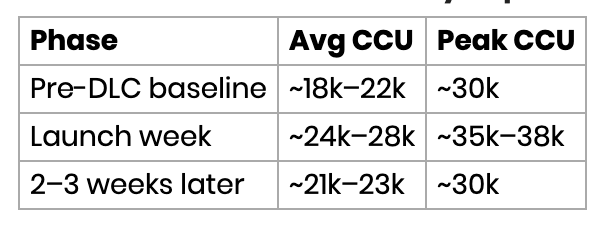
Estimated Lift:
20–30% launch-week concurrency bump
DLC- driven monetization (skin conversion > gameplay conversion)
Insight
Unlike platform-wide collabs (e.g., Fortnite), this was:
Why Dead by Daylight performs Better Than Hunt Showdown:
Dead by Daylight is arguably Steam’s strongest licensed IP integration engine.
What the above shows is not only that integrations in Steam games can be incredibly successful, when done right, but they have to be done carefully so as not to alienate audience engagement and retention. Dead by Deadlight is a benchmark to be proud of but the same opportunity exists in every other genre of IP.
Why not start that ideation process with us. We would love to talk that through and see how we can assist you.
In Brief
Here are some of our favourite recent and announced brand collaborations and licensing partnerships from the last month:
In other news…
