
.png)
A catch up of some of the best examples of IP licensing in video games and the latest news on collaborations, brand partnerships, in-game events and the industry as a whole.
This last month or so we’ve seen further upticks of licensing activity across the games and gaming industry. Even strategic acquisitions of interest from IP owners also.
The games and licensing industry continue apace with next month bringing the Brand Licensing Europe show in London and many gaming events around the world.
A recent trip to Germany for us brought new projects to the table and we’ve got two major IP portfolio additions coming to the marketplace soon.
IP Spotlight this month covers examples of the many great IPs available within the Layer marketplace ecosystem.
Developer Diaries highlights more examples of creative companies utilising the Layer and AT New Media on and off marketplace licensing support services to try and evolve new opportunities for existing and future game projects.
Finally, we share some of the usual industry news stories, update snippets from the world of gaming collaborations and more.
For further information on Layer, what we are doing now and more, please reach out to Simon@layerlicensing.com
.png)
We’re now seeing the licensing landscape be much broader than games just licensing characters.
There are seemingly several distinct strategies emerging.
Sure there are developers buying access to proven entertainment IP, but even more game owners are licensing their own IP outward, platforms making licensing scalable, and media companies vertically integrating into games.
Feels like a cycle we’ve seen before but perhaps we’re back!
Here are some recent examples that demonstrate this.
1. Frontier Dev + Disney:
Entertainment IP being matched to a proven game format
Frontier announced an agreement with Disney to develop and publish a new game using Disney IP. Importantly, Frontier is fully funding the game itself, and it is explicitly positioning the project within its creative-management-simulation strategy alongside Planet Coaster, Planet Zoo and Jurassic World Evolution.
Why do it?
This is a fairly sophisticated form of licensing rather than simply “put Disney characters in a game.”
Frontier gets:
• access to an enormous pre-existing global audience;
• a recognisable IP around which to build a potentially evergreen simulation game;
• lower brand discovery risk than launching another completely unknown universe;
• the opportunity to apply a genre capability it already owns to a new IP.
Disney, meanwhile, gets a game made by a developer whose business model is already builtaround long-lived management/simulation franchises, rather than having to build that capability internally.
The interesting bit is the fit between IP and gameplay format. Frontier isn't just renting Disney characters for a cosmetic crossover. It is trying to make the Disney IP the foundation of a new game/franchise.
Strategic model:
Licensor IP + specialist developer capability → new game franchise.
2. WEBTOON + RI Games:
Turning an IP library into a games factory
WEBTOON agreed to acquire a 60% stake in RI Games Holdings for approximately $100m, giving it a dedicated games-development pipeline. The plan covers multiple games over four years based on established WEBTOON properties including Overgeared, Doom Breaker and Omniscient Reader.
This is much more consequential than a conventional licence.
WEBTOON's stated logic is essentially:
Webcomic → animation → game → wider franchise.
For example, Overgeared is being developed as an action MMORPG, with the game and anime being coordinated around the same period.
Why do it?
WEBTOON already owns access to the audience and IP, but historically it has depended on partners to turn those properties into other forms of entertainment.
Buying into the development infrastructure gives it:
• more control over game development;
• a greater share of downstream economics;
• a repeatable way to convert successful webcomics into games;
• the ability to coordinate releases across anime, games and comics;
• another monetisation route for IP that has already demonstrated audience demand.
The really interesting strategic insight is that games aren't being treated as an adaptation after the fact. They're becoming one component of the original franchise architecture.
WEBTOON explicitly says that each additional format can feed audiences back into the original series and expand the overall franchise.
Strategic model:
Owned IP + owned/controlled development capability → multi-format franchise machine.
3. Roblox: Potentially the biggest change in the economics of IP licensing
This is less about one IP deal and more about changing the infrastructure of licensing.
Roblox has introduced an “in-game sales” licensing model. Previously, a creator generally licensed an IP for an entire game and the revenue share applied to the game's earnings. Under the new system, licensed IP can instead be associated with particular game passes and developer products, with the revenue share applying specifically to those items.
DevForum:
Roblox also added three Kodansha franchises to its licensing catalogue.
Why is this important?
It potentially changes the economics from:
“I need to make an entire licensed game.”
to:
“I can make my game and license a specific piece of commercial content within it.”
That makes the addressable creator base much larger.
A small Roblox developer might not want to commit to licensing an entire experience around an anime franchise. But they might want to sell:
• a licensed character;
• a costume;
• a weapon;
• a vehicle;
• a game pass;
• a special ability;
• a themed item.
Roblox itself describes its broader objective as building an ecosystem where rightsholders can license IP to creators at scale. Its License Manager is designed to let rights holders register IP, manage licences and monitor usage.
Creator Hub:
And this sits alongside Roblox's much broader push to become a platform that works across PC, console, mobile and eventually standalone applications.
Roblox:
The strategic implication
This could make IP licensing behave more like an app-store ecosystem.
Instead of a small number of large developers negotiating large licences, potentially thousands of creators can participate in the market.
Strategic model:
Licensing infrastructure + creator economy → massively distributed IP exploitation.
4. CD Projekt:
Licensing the game IP outward
This is the other side of the equation.
CD Projekt's recent results explicitly said that licensing its IP is becoming increasingly important to the company.
The company describes Cyberpunk as having become a broader franchise extending beyond games, pointing to Cyberpunk 2077 content appearing in Wuthering Waves and Apex Legends, alongside the Cyberpunk TCG and Edgerunners.
CD PROJEKT RED:
That's significant because CD Projekt isn't primarily saying:
“We need another game to sell.”
It's saying:
“The underlying IP itself has economic value outside our games.”
Why do it?
There are several advantages:
• monetise an IP between major releases;
• keep characters/worlds culturally visible;
• introduce the IP to audiences playing other games;
• create incremental licensing revenue;
• reduce reliance on the sales cycle of a single AAA release;
• reinforce the value of the franchise ahead of future releases.
And there is evidence that this is becoming a material business activity: CD Projekt's CFO said licensing made a significant contribution to first-half 2026 revenues and described it as an activity that is becoming progressively more important.
The September partnership with Blizzard is a particularly good example of this broader approach: Cyberpunk 2077 is coming to Battle.net, while Overwatch is scheduled to receive Cyberpunk: Edgerunners content in 2027.
Strategic model:
Game franchise → external games/platforms/media → licensing revenue + audience expansion.
5. IGG / Lords Mobile × Transformers:
Live service games as licensing vehicles
Yodo1, acting as licensing representative and collaboration partner, worked with IGG and Hasbro to bring Transformers into Lords Mobile.
The collaboration introduced characters including Optimus Prime, Bumblebee and Megatron alongside themed gameplay and rewards.
This is the classic live-service licensing model.
Why?
For a mature mobile game, licensed IP can provide a reason for an existing player to return. Rather than needing to develop a completely new game, the developer can inject:
Recognisable IP → new event → new content → renewed engagement → monetisation
The IP owner gets:
• licensing revenue;
• exposure to a different audience;
• another consumer touchpoint for its franchise.
The game developer gets a marketing event and potentially higher engagement without building an entirely new IP.
This model is particularly compatible with mobile because live-service games already have an infrastructure for temporary events, characters, skins, currencies and rewards.
6. Nex × Bandai Namco: Taking established game IP into a different category
Nex announced a licensing partnership with Bandai Namco to bring PAC-MAN to Nex Playground, its active-play platform.
This is interesting because PAC-MAN isn't being used simply to make another traditional videogame.
It's being used to reposition a classic game IP around family physical activity.
Why?
For Bandai Namco, the opportunity is to:
• introduce PAC-MAN to younger/family audiences;
• extend the franchise beyond conventional gaming;
• exploit a 45-year-old brand in another form of play.
For Nex, PAC-MAN provides instant brand recognition and helps establish its platform as a home for recognised entertainment properties.
Strategic model:
Legacy game IP → adjacent category/platform → new audience.
7. WildBrain + Personality AI: Licensing IP into AI experiences
This one isn't strictly videogame licensing, but I'd include it in a wider industry lens because it points to where elements of the licensing market are going.
WildBrain recently acquired Personality AI, describing its technology as enabling interactive character experiences that can be built once and deployed across multiple platforms.
One existing example is Hey Peppa Pig, an interactive AI experience developed with Hasbro for Amazon Kids+.
WildBrain Investors….
Why is a games/IP person likely to care?
Because it broadens the definition of what the licensable asset actually is.
Historically:
IP → toy / game / TV show / merchandise
Increasingly:
IP → interactive character → AI companion → game → social experience → merchandise
WildBrain explicitly talks about each character experience becoming a durable, licensable asset and about creating an “always-on” interaction with the franchise.
That suggests the future licensing market may not be limited to putting a character into a game. The character itself becomes an interactive software product.
8. Upper Deck × Hasbro: The broader IP licensing ecosystem
Another useful data point is Upper Deck's recent agreement with Hasbro covering Transformers, Power Rangers, G.I. Joe, M.A.S.K. and Jem and the Holograms for trading cards and games.
It isn't videogame licensing, but it demonstrates the same strategic behaviour from a major IP owner:
One IP portfolio → multiple specialist licensees → multiple consumer categories.
Hasbro can simultaneously exploit its franchises through:
• videogames;
• tabletop games;
• trading cards;
• toys;
• film/TV;
• collectibles;
• digital experiences.
That's becoming an increasingly important distinction: the IP owner doesn't necessarily need to make the product itself.
.jpg)
This story naturally follows on from the above this month and we’ve grouped the activity into five strategic shifts.
1. Developers are increasingly renting audience, not just characters
The attraction of Disney, Transformers, PAC-MAN, WEBTOON etc. isn't simply the characters.
It's the pre-existing relationship with consumers.
For a new game, acquiring attention is expensive. A recognisable IP effectively brings a partially assembled audience with it.
That's particularly valuable when development budgets and marketing costs are high.
2. IP owners increasingly want to participate in the entire lifecycle
The WEBTOON transaction is a good illustration.
Instead of:
“Here's a licence. Come back when the game is finished.”
the model becomes:
“We own the audience, control the IP, own part of the development infrastructure and coordinate the game with our other media.”
That potentially gives the IP owner much more control over economics and brand development.
3. Live-service games make licensing repeatable
The Lords Mobile × Transformers model illustrates this.
A licence doesn't necessarily need to generate one standalone product.
It can generate:
• launch event;
• character release;
• cosmetic content;
• seasonal event;
• sequel collaboration;
• anniversary event;
• merchandise.
So the commercial value of an IP can be amortised across repeated content drops.
4. Platforms are trying to industrialise licensing
Roblox is perhaps the clearest example.
The traditional licensing industry is certainly cumbersome:
Licensor ↔ lawyer ↔ publisher/developer ↔ contract ↔ approval process ↔ product
Roblox is attempting to turn that into:
IP catalogue → creator selects IP → licence→ build → sell → revenue share
If that works at scale, it could substantially lower the transaction cost of IP licensing.
5. The most valuable game companies increasingly own IP and development capability
There are two very attractive positions emerging:
Position A — IP owner
CD Projekt, Hasbro, Disney, WEBTOON, Bandai Namco etc.
They can license their IP into many ecosystems.
Position B — specialist developer
Frontier, RI Games and others.
They can take proven IP and convert it into successful game formats.
The really powerful position is owning both.
WEBTOON is moving in that direction by acquiring development capability; CD Projekt is already demonstrating the value of owning major game IP and licensing it outward.
All of this enables us to build a matrix of occurrence and variables within the market as follows:
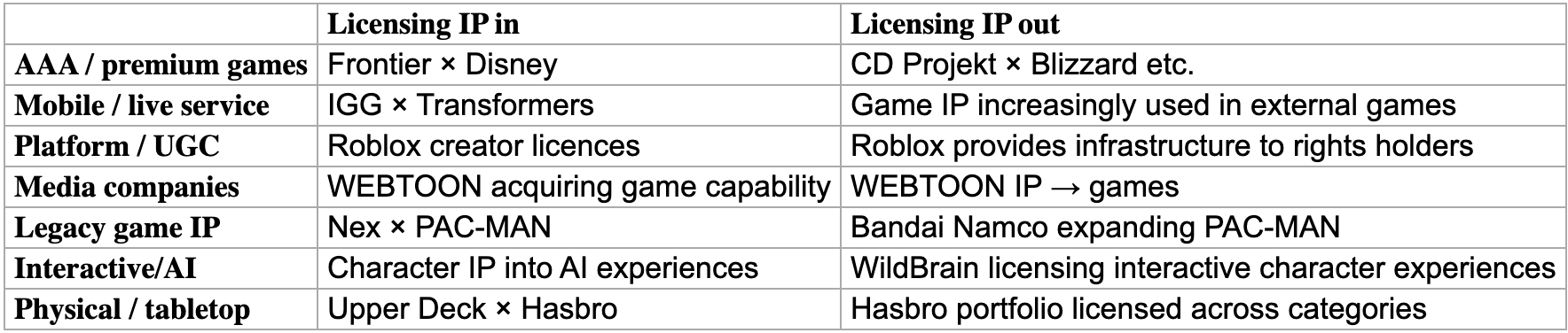
That tells us the important development isn’t simply “more game licensing.”
It is the movement toward IP ecosystems, where the same intellectual property can simultaneously exist in a game, another company’s game, anime/TV, merchandise, collectibles, AI experiences, UGC platforms and physical products.
The commercial logic behind the trend….
There are basically four economic problems these companies are trying to solve:
1. Customer acquisition
Known IP reduces the amount of work required to explain why consumers should care.
2. Development risk
A developer can combine an existing fanbase with its own proven gameplay expertise.
3. Franchise utilisation
An IP that produces one game every 4–5 years is potentially underutilised. Licensing creates activity between releases.
4. Monetisation of fandom
The same fan can now be monetised across games, DLC, skins, collectibles, cards, merchandise, anime, events and other experiences.
That's why we pay particular attention to Roblox, WEBTOON and CD Projekt alongside the conventional Disney/Hasbro deals.
They represent three different attempts to make IP licensing structural rather than transactional.
One important caveat….
The announcements aren't all equivalent. Some are new licence agreements, some are strategic investments, some are platform infrastructure changes, and some are examples of an existing licensing strategy becoming more explicit. We’ve separated those concepts rather than treating every crossover as a comparable “licensing deal.”
What else do we see… does it in any way change the prior perspectives?
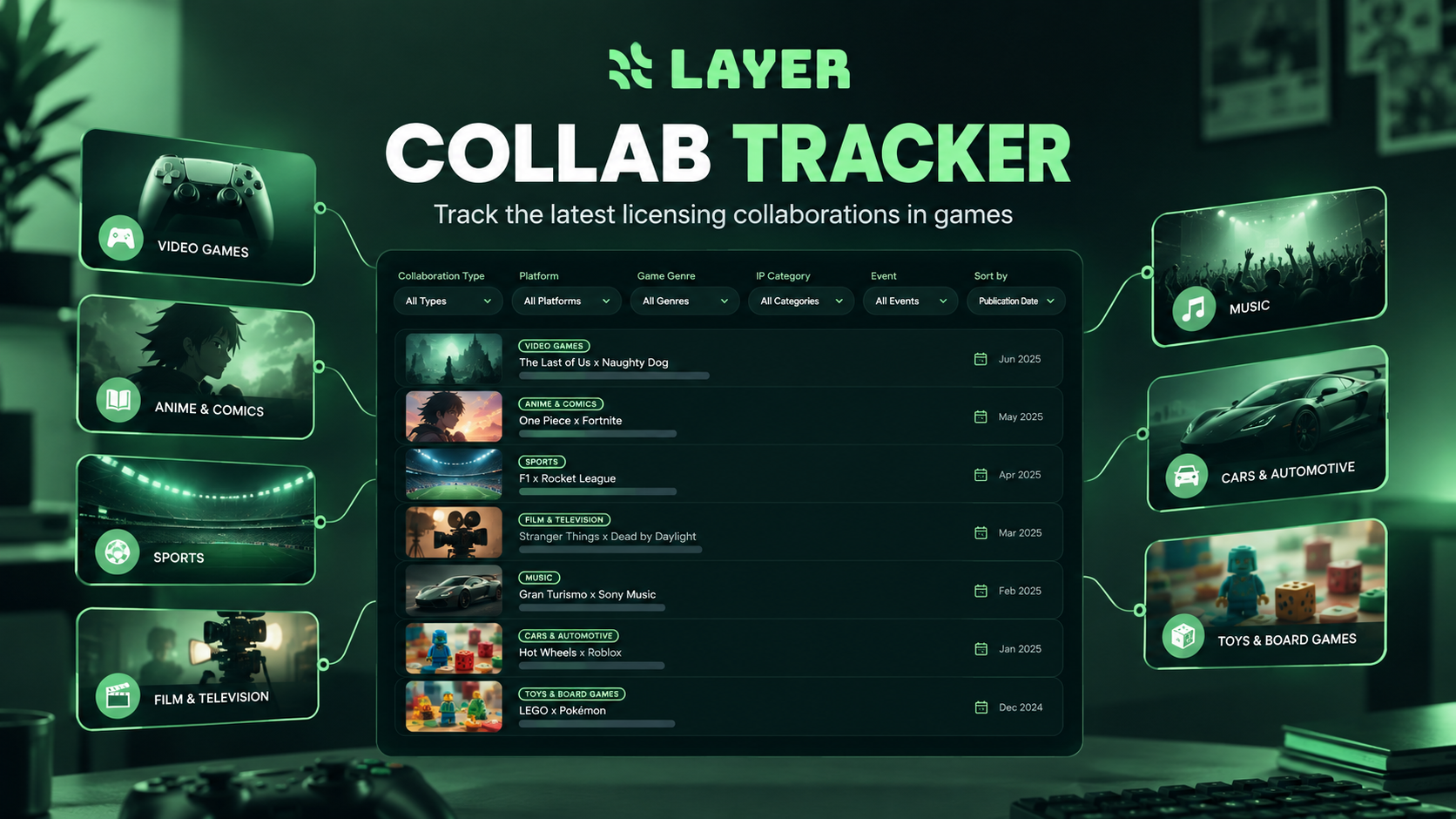
Our tracker is useful because it captures a much broader set of collaborations than the headline corporate announcements we highlighted above.
Here’s some other examples that further the conversation…
Stellar Blade × Bayonetta:
A particularly interesting game-to-game IP collaboration..
Stellar Blade is getting four Bayonetta-inspired costumes, including Bayonetta, Jeanne and other looks.
This is worth adding because it's a good example of game IP owners licensing to another game rather than to a completely different entertainment medium.
The commercial logic is quite different from Disney × Frontier:
• Stellar Blade gets a recognisable character/fashion hook for existing players.
• Bayonetta gets exposure to an adjacent action-game audience.
• Neither company has to build a new standalone product.
• The IP can be monetised through a relatively inexpensive digital-content layer.
Strategic category: IP-to-IP audience exchange.
We regard this as part of the growing “licensing as live content” model rather than conventional game licensing.
Free Fire × Naruto Shippuden:
A more sophisticated live-service licence…
Featuring the Hidden Leaf Village, Ninjutsu Scrolls, Sharingan Mechanics, Nine Tails events and other gameplay systems—not simply character skins.
This is more interesting strategically than a basic cosmetics collaboration.
The developer is effectively asking:
Can an external IP provide new gameplay mechanics as well as marketing appeal?
That matters because the licence becomes embedded in the gameplay loop, rather than sitting on top of the game as decoration.
There are also obvious reasons for Naruto's rights holder to participate: the game provides a huge established mobile audience and a mechanism for repeatedly exposing that audience to the franchise.
Strategic category: licensed IP as gameplay/content infrastructure.
AFK Journey × Digimon:
IP + mechanics rather than IP + skins
The collaboration brings Taichi, Yamato, Agumon and Gabumon into AFK Journey, with Digivolution gameplay incorporated into the RPG.
Again, this is worth separating from a cosmetic crossover.
Digimon is unusually well suited to this because evolution is itself a game mechanic. The licence therefore supplies both:
• characters with established recognition; and
• an existing gameplay concept that can be translated into the host game.
That makes this a good example of IP-specific mechanics being licensed alongside characters.
MapleStory × Frieren:
Older game + contemporary anime audience
Nexon announced a new storyline based around Frieren, Fern and Stark, rendered in MapleStory's distinctive visual style.
This is strategically interesting because MapleStory is an established game rather than a new release.
The licence therefore serves a slightly different purpose:
Established game → inject contemporary cultural relevance → give existing players a reason to return → expose a newer audience to the older game.
This is increasingly important for long-running MMOs and mobile games whose underlying gameplay infrastructure can remain viable for many years.
Strategic category: catalogue rejuvenation through external IP.
Fortnite × Tetris:
Another useful example of “brand translation”
Tetris content coming to Fortnite, including a Tetris-themed Mythic item.
This is interesting because Tetris is almost the opposite of Persona in terms of IP characteristics.
There's no obvious character universe to import.
Instead, the core visual language and gameplay concept becomes the licence.
That suggests the licensing opportunity isn't necessarily:
“Put our character in your game.”
It can be:
“Translate some recognisable element of our IP into your game's mechanics.”
That's a potentially much broader market.
Demeo × Dungeons & Dragons:
Perhaps one of the better examples of genuine IP/product fit
Demeo x Dungeons & Dragons: Battlemarked, with the new campaign Twilight's End and the game expanding onto Xbox.
We put this alongside Frontier × Disney because the IP and the developer's existing capabilities are unusually compatible.
Demeo already operates in the tabletop-inspired tactical RPG space. D&D therefore isn't just an attractive brand - it is conceptually aligned with the underlying product.
That's the sort of licensing deal where the IP can potentially increase the addressable audience without fundamentally changing what the developer is good at.
Strategic category: high-fit IP licensing.
Captain Tsubasa × Zoids:
Interesting because the IP is being integrated into the character system
The collaboration introduces seven crossover players, each associated with a Zoids character, with special artwork and skills based on the corresponding Zoid.
This is a particularly good example of licensed IP becoming a collectible/character progression mechanic.
It demonstrates why mobile games are such fertile territory for licensing: the underlying systems - characters, rarity, progression, collection, limited-time events - are already designed to accommodate new IP.
Clash of Clans × WWE:
Licensing reaching into “strategy” games
It's useful because it reinforces that licensing isn't restricted to genres where characters naturally fit.
A wrestling IP can be translated into a strategy/base-building ecosystem.
That's evidence of the increasing importance of the host game's systems: if the game has a strong enough content architecture, almost any recognisable IP can potentially be translated into it.
Subway Surfers × Among Us:
IP recycling between successful games..
The collaboration brings Among Us characters back into Subway Surfers, including Crewmate playable characters and returning cosmetics.
This is interesting because it's effectively licensing between digital game franchises, rather than Hollywood/anime IP entering games.
That is a trend to watch closely.
Game companies have spent decades building valuable IP, and we're now seeing those assets become licensable entertainment properties in their own right.
That's the same fundamental phenomenon we see with CD Projekt's Cyberpunk strategy.
Two others we’d like to highlight…
Mutant Football League 2 × GWAR
GWAR became a playable team in Mutant Football League 2, with named GWAR members represented as characters.
This is a good example of niche IP matching a niche game audience.
It doesn't have to be Disney-scale to make commercial sense. A smaller but highly engaged fanbase can be particularly valuable where the host game already appeals to that demographic.
Fatal Fury × Tokyo Revengers
Fatal Fury: City of the Wolves is bringing Tokyo Revengers characters Mikey and Draken in as DLC characters.
This is another example of cross-medium IP being converted directly into premium playable content, rather than a free promotional event.
That distinction matters commercially because the licensed IP can become part of the game's monetisation architecture.
How does Layer add to the overall picture?
Having reviewed our own tracker, we can actually revise the earlier thesis slightly.
There are three licensing markets operating simultaneously.
A. “Big IP → game”
Disney → Frontier
D&D → Demeo
Transformers → Lords Mobile
Frieren → MapleStory
Naruto → Free Fire
This is the traditional licensing opportunity.
B. “Game IP → game”
Bayonetta → Stellar Blade
Persona → Fortnite
Tetris → Fortnite
Among Us → Subway Surfers
Cyberpunk → other games
This is the one I think is particularly important.
Games themselves are becoming major licensing properties.
A successful game isn't merely a product anymore. Its characters, worlds, visual identity and mechanics can become licensable assets.
C. “IP becomes a modular content layer”
Roblox is the extreme example, but Free Fire, Fortnite, MapleStory, Clash of Clans, Captain Tsubasa and others are moving in this direction.
The licence can be broken into:
• character;
• skin;
• cosmetic;
• item;
• mechanic;
• map;
• quest;
• event;
• narrative;
• collectible;
• DLC etc.
That makes the licensing opportunity much more granular.
The really interesting signal from our Tracker…
It actually makes the frequency of these collaborations much clearer than corporate announcements will ever do. One reason why we do it!
We record a dense run of deals involving anime/manga, other videogames, film/TV, sports, automotive and music IP.
So if you're analysing this commercially, we wouldn't make the headline:
“Game developers are licensing more IP.”
It is more like:
“Games are becoming an increasingly important distribution layer for other people's IP and successful games are themselves becoming licensable entertainment brands.”
That's a much more consequential shift.
And our data supports that distinction particularly well, because you can see the same phenomenon happening from both directions: entertainment/anime/toy/sports IP entering games, while game IP such as Bayonetta, Persona, Tetris and Among Us is being exported into other games.
IP Spotlight:
We’ve already highlighted in recent months how the Layer marketplace ecosystem has amazing opportunities for developers across multiple genres of IP. You can use them for ideation and make enquiries as you see fit.
Here’s a few individual IPs you may find interesting which have seen engagement upticks in recent times.
BOB ROSS
One of the world’s most iconic creatives who has been involved in many game projects over recent years. Soon to see life in another we’re proud to support.
RAMBO
A new release by one of our developers sees all iconic Rambo characters come to life in a new content integration.
MOTORHEAD
Music integrations are always enjoyable to work on especially when inclusive of iconic band assets.
PUBLISHERS CLEARING HOUSE
An iconic US gaming brand that’s currently available to license on Layer having recently joined. Whether for lottery or other concepts, developers are welcome to make enquiries on marketplace.
Overall IP additions to the Layer marketplace have steadily increased recently with our initial strategic commitment to onboarding more IPs to complement existing strategies. There are some really great ones to come!
Layer continues to form part of both licensors and agents outreach strategies together with developers inbound IP acquisitions.
If you are an IP owner or agency seeking to open up new conversations through collaborating with the Layer marketplace and the support services offered by AT New Media, we welcome conversations as to how we can reach mutually beneficial markets.
Developer Diaries:
Wherever you are in your development lifecycle when it comes to licensing initiatives, we are pleased to have you with us and we’re here to help.
A brief bit of information on some of the developers we continue to and have engaged with both on and off the Layer Licensing Marketplace.
We’ve been busy offering licensing guidance and opportunity delivery whether that’s via Ideation, Search or Commercial support.
ONE EYED ROBOT
Multiple product ideation and IP search for console and handheld platforms.
ANONYMOUS LABS
Creating new secure cryptography revenue streams for IPs in games and associated digital content wrappers with some notable success to date.
HYPERLUMINAL
Creative and ambitious UK based studio keen to build new partnerships.
PLAYNOOK
Supporting ideation for audio games. Yes, audio games….
If you are a content developer seeking to start a journey with IP licensing or are a seasoned pro and are seeking additional support, we have the options available to help you both on and off marketplace.
From ideation and search to commercial proposal drafting and support, we’re here to help.
Release Notes – Layer Collaboration Updates:
As you read each month and herein, we collaborate with developers, licensors and agents in many ways.
Supporting ideation and search through to commercial deal delivery, we like to mention some of our own work from time to time.
We’ve seen multiple product launches of projects utilising IP sourced from the Layer marketplace.
We’re a complimentary tool and can assist you with your licensing objectives whether inbound or outbound.
We don’t promise the world but we do promise commitment to the cause and are proud of our diligence in supporting licensing projects come to successful conclusions.
Please follow our LinkedIn Page for updates on all of the above and more.
In Brief…
Here are some of our favourite recent and announced brand collaborations and licensing partnerships from the last month:
Remember to keep an eye on our Collab Tracker for regular updates on collaborations we love (including some of ours of course) from the whole games and gaming industry.
In other news…
Thanks again to everyone who is working with our agency AT New Media covering consultancy, ideation and search alongside the Layer marketplace. Don’t ever think we don’t have outreach to the whole IP licensing market.
If you have a story to tell or would even like to share some news for our monthly newsletter, please do get in touch.
